The Prime Minister, Social Media Surgeries and Me

The Prime Minster, David Cameron, really likes me. He’s just given me a “Big Society” award.

Well, not just me, but the whole Social Media Surgery movement, of which I’m proud to be a part. I’ve been standing on the shoulders of, and often shoulder-to-shoulder with, giants.

It all started in 2008, when a couple of very clever friends of mine, Pete Ashton and Nick Booth, decided to hold an event, in Birmingham, to which anyone from a not-for-profit organisation was invited, and where they would get free assistance in using the web, and especially social media tools, to promote or conduct their socially-useful activities, with “no boring speeches or jargon”.

The event — dubbed a Social Media Surgery —  went so well that they decided to repeat it regularly, and as soon as I head about it, I offered my assistance. I’ve been involved ever since.

Over the last three or four years, as well as the original and on-going Central Birmingham surgery, I’ve helped at Social Media Surgeries in Aston, Coventry, Digbeth, Dudley, Perry Barr, Stourbridge and elsewhere, I’ve also set up and run sessions near where I live in Oscott, north Birmingham, and in Walsall, and more impromptu Social Media Surgery sessions at unconferences like LibCamp.

I’m not alone. Surgeries directly spun off from what we do in Birmingham have been held in over 50 towns and cites, in pubs, community halls and cafes, on trains, and in tents at country fairs, and in several other countries.
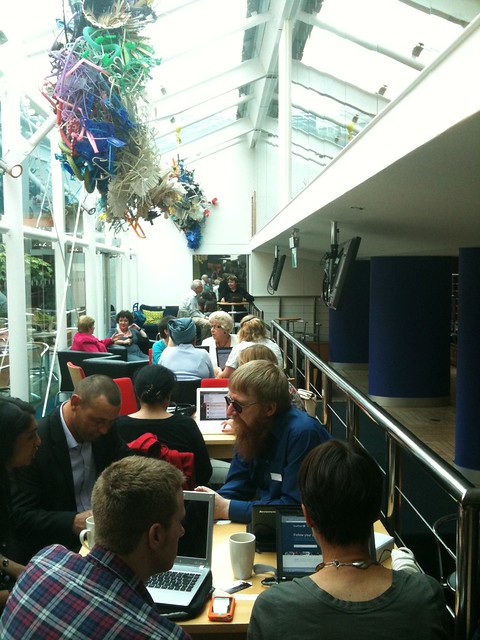

Me, in my cool shades, helping at Central Birmingham Social Media Surgery in July 2011. © Gavin Wray, CC-BY-NC-SA

Literally hundreds of organisations have benefited. I personally have helped bereavement counselling services, organic fair-traders, residents’ associations, target-shooting rifle clubs, arts festival organisers, parks’ friends groups, model railway clubs, Oxfam supporters, art galleries, cyclists’ groups, hospices, local historians, and many others, to use Facebook, Twitter, WordPress, Flickr, Google Docs, and a host of other online tools. I’ve even taught a few to edit OpenStreetMap or edit Wikipedia, and to avoid conflicts of interest when doing the latter, by declaring them and not being overly promotional.

It’s been one of the most rewarding of the many voluntary activities I’ve performed. And as a result of all our work, we have now received the aforesaid award.

The Prime Minster said:

This is an excellent initiative — such a simple idea and yet so effective. The popularity of these surgeries and the fact that they have inspired so many others across the country to follow in their footsteps, is testament to its brilliance.

Congratulations to Nick and all the volunteers who have shared their time and expertise to help so many local groups make the most of the internet to support their community.

If you work or volunteer for a non-profit organisation, why not pop along to your nearest surgery? And if you already use such tools, even a little, why not pop along and offer to share your knowledge? If there isn’t a surgery near you, why not set one up?

On the other hand, your work is commercial (or you work for a not-for-profit organisation, but require additional or more intensive support), that’s part of what I do for a living. I’d be happy to hear from you.

I should also comment on the name of the award, since the surgeries have been running long before the current government came to power and before their “Big Society” brand was heard of, and would be held even if neither of those two things had occurred. We do this because we want to give to the community and help those who are prepared to try to improve their world, not because of a political ideology.

In closing, my thanks and congratulations, to my fellow surgery managers and surgeons (many of whom have written blog posts about receiving the award), especially those who’ve helped at the surgeries I’ve run and to the patients, whose appreciation and continued use of what we’ve shown them, make it all worthwhile.

Politician pin ups – open-licensed pictures, please

Politicians, like visits to the dentist and taxes, are a necessary evil. We all moan about them, but someone has to take care of the machinery of state.

So it’s important that we hold them to account, and elsewhere document their activities in a neutral way. Hyperlocal bloggers do the former, and the latter takes place on Wikipedia, and on sites like the excellent OpenlyLocal (both of whose content is open-licensed).

To illustrate such articles, bloggers and Wikipedians need photographs of the politicians (and senior officers). While it’s possible for individuals to take such pictures (and even open-license them, as I described previously), it would be better if such pictures were available from official channels. Such organisations already take or commission professional quality shots and make them available to the press. If they don’t already, they should make sure that their contract with photographers pays for full rights, enabling open-licensing.

I recently asked Birmingham City Council’s press office to make their pictures of members of BCC’s cabinet available under an open licence, and, to their credit, they did so. I was then able to use one of them on :

Wikipedia article using a picture open-licensed by Birmingham City Council

Some might ask “but what if the pictures are misused, to misrepresent those people”. Well, if someone’s going to do that, then they won’t bother about copyright anyway, and other laws (libel, human rights) already enable redress.

So come on all you councils, civil service departments, police forces/ authorities and so on — let us have pictures of your elected members and senior officers, free (i.e. with no “non-commercial” or “no derivatives” restrictions) for reuse on our blogs, Wikipedia and other sites. Major companies, too, could do this for their most-public board members.

Then there’s all public bodies’ other photographs. After all, West Midlands Police kindly agreed to my request to open-license the fantastic aerial shots from their helicopter…

St. Martin in the Bullring Church, Birmingham
Birmingham’s Bull Ring, from the West Midlands Police helicopter. Although this picture is ©WM Police, I can use it, here and on Wikipedia, because they kindly make it available under a CC-BY-SA licence

Lightning Talks Strike Twice

I very much enjoyed attending Local Gov Camp North West last weekend. Although it was attended by fewer people than other unconferences I’ve been to (due to people crying off for fear the impending snowpocalypse would leave them stranded in northern wastelands; I mean Preston), this meant it was a more intimate event, the smaller groups allowing everyone a chance to speak more. I curated lots of links tweeted during the event, using Pinboard.

IMGA0025

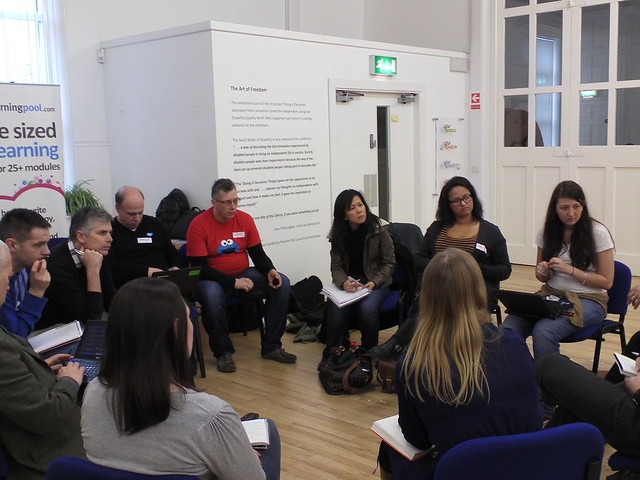
Rapt attention at Local Gov Camp North West — pic © John Popham, CC-BY-NC-SA

With some attendees also leaving early as news of snowbound roads and delayed trains filtered through to us, it seemed that we wouldn’t be able to fill the final hour’s worth of breakout sessions. This gave me the chance to propose trying something I’ve wanted to do at a GovCamp since experiencing them at GLAMCamp Amsterdam last December: lightning talks.

The three-day GLAMCamp event had one hour of such talks scheduled, but they proved so popular that it was agreed to set aside another two. Anyone who had an idea to pitch, a story to share or a problem they wanted help to solve, could speak for a maximum of five minutes (less if that was all they needed), but unlike most unconference sessions, they could speak to most of the attendees at once.

Details of the GLAMsterdam lightning talks were captured on an Etherpad for Saturday and an Etherpad for Sunday, which have links to individual videos of several of the talks.

Because the lightning talks were only a few minutes long, there wasn’t really time for people to grow bored if a particular talk wasn’t relevant to them, and they could always check their mail or social media, grab a drink or take a comfort break if they did. I gave a quick, inpromptu talk on my deployment of microformats on Wikipedia. Many people, who wouldn’t have elected to come to a full session on the topic, told me they found it useful.

I’m glad to say people at #LocalGovCampNW (as we hash-tagged it) readily accepted my proposal and am grateful for that, and their participation. We restricted the talks to just three minutes (I was ruthless with my stopwatch app), and despite people having had little time to prepare (which I think was a disadvantage), and no use of Powerpoint (unlike at GLAMcamp), we managed to cover several topics in about 20 minutes, ranging from SMS alerts to data visualisation and from promoting an upcoming event, the Eureka Festival of Resources, to my talk on BrewCamp. While some talks were curtailed after the allotted time, conversations could be and were continued afterwards, and online; the interested participants having had the opportunity to identify one another.

John Popham caught the talks on video, as part of his “celebration2.0” project :

Daniel Goodwin, Chief Executive of St Albans City & District Council, said they “provided an interesting insight into people’s concerns“.

Why not try a session of lightning talks at your next unconference?

Bullet points from UK Govcamp 2012

I spent Friday and Saturday at UKGovCamp2012, a splendid unconference, in London, for people interested in the use of digital technologies in local and national government. Or “Glasto for Geeks” as it has famously been described. My friend and fellow attendee Dan Slee has suggested that we all blog a list of 20 thoughts we brought away from the event. I’m happy to oblige.

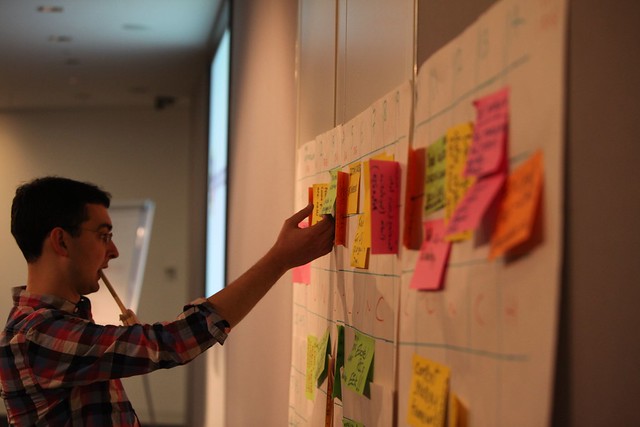
Steph Gray planning sessions at UKGovCamp 2012. Picture by David J Pearson; some rights reserved.

  1. Our national and London rail systems are overpriced, and the former’s ticketing is ridiculously over-complicated.
  2. It’s a good idea to walk (or cycle) through London, rather then getting the tube. You’ll see great architecture and public art, and get a better impression of how the various districts are laid out. But wear sensible shoes.
  3. Geeks do have great senses of humour. Especially those at our generous hosts and butt of jokes, Microsoft.
  4. There is still a lot of uncertainty about Open Data — what’s it for, what do we want, how should we use it. This is good, because — despite some valid concerns about the centralisation of innovation more generally — there is still room for us to innovate with Open Data.
  5. There are a lot of Brompton bikes in London. I’m determined to take mine on a future trip.
  6. We need better systems in place for using social media in responding to emergency situations. Expect some exciting news about a new project I and some fellow attendees are planning, soon.
  7. Anke Holst does not appear old enough to have a teenage child.
  8. When beta.gov.uk comes out of beta, and current .go.uk domains are “retired”, it’s really, really important that existing links to them, from external sites, still work. And by work, I mean go to relevant content, not a home page. As a very wise man once said, “Cool URIs don’t change“.
  9. It’s possible to spend one or two days at an event with good friends, and still fail to manage to say hello to them. Apologies if that’s you.
  10. Open Data and Freedom of Information are the two are opposite sides of the same coin. If an organisation has people responsible for Open Data and FoI and those people are not either the same, or closely linked, then that organisation has a problem.
  11. Terence Eden is not only (with ) a generous host, but also an impressively entertaining speaker. If his day job fails (it won’t) he has a viable alternative career in stand-up observational comedy. I went to his QR code session not only to learn, but to enjoy.
  12. If you ask them, people who share will kindly change their settings, so others can tag them.
  13. If you put three expert™ Wikipedia editors together in a room you will get at least four interpretations of the Conflict of Interest policy.
  14. Twitter still rocks. Its so ubiquitous (to us) that we forget that; and that some people still don’t get it.
  15. There are — contrary to popular perception — people working in Government who are keen to and do, make the images they produce available under open licences, so that others may reuse them. OpenAttribute may be useful to them.
  16. I want a Scottevest!
  17. People like having the #ukgc12 bookmarks curated on Pinboard.
  18. People recently turned, or thinking of becoming, freelance need more advice and help, and perhaps a support network.
  19. If our wonderful organisers Dave Briggs and Steph Gray are “the Lennon and McCartney of gov digital people”, who is going to be The Frog Chorus?
  20. Beer tastes even better when it’s free. Thank you, kind sponsors.

See you there next year!

Transport Scotland/ ScotRail refuse plaque marking Jordanhill Station as subject of one-millionth Wikipedia article

A railway station in Glasgow, Jordanhill, is the subject of , as noted in Wikimedia’s 1 March 2006 press release.

Screenshot as of 19 January 2012

Because of this, the article has been translated into Wikipedias in many other languages, including:

Screenshot of language links

Alemannisch, Arabic, Welsh, Danish, German, Greek, Spanish, Esperanto, French, Indonesian, Italian, Latin, Dutch, Japanese, Polish, Romanian, Russian, Simple English, Finnish, Swedeish, Thai, and Chinese

(you can see links to these in the left-hand column of the article; please let me know if you can translate it into other languages).

Last December, I wrote to , an executive agency of the Scottish Government’s Enterprise, Transport and Lifelong Learning Department and as such accountable to Scottish Ministers, suggesting a plaque be erected on the station, noting this milestone, in collaboration with WikimediaUK, the registered charity that supports Wikipedia and related projects in the United Kingdom. I proposed that the plaque would include a barcode, allowing overseas visitors to see the article in their preferred language.

I have today received their reply, which appears to employ a stereotypical bureaucratic lack of imagination.

Jordanhill station is owned by Network Rail and leased along with the vast majority of all other railway stations in Scotland to First ScotRail to manage and operate on a daily basis.

I have discussed with ScotRail your proposal to install a plaque at the station to mark the one-millionth article on Wikipedia about Jordanhill. We do not wish to take this forward.

ScotRail has been delivering a comprehensive station re-branding programme which began in 2008 and will be complete in 2014. There are Brand Guidelines in place for this programme which aims to simplify and unify all station branding and this includes the removal of information from third parties.

I’m open to suggestions as to how to proceed, and who (and whether) to lobby to have the matter reconsidered. What do you think?

Talking about GLAM, Wikipedia and QRpedia in Amsterdam and Hamburg

During the first weekend of December, I was in Amsterdam, at the invitation of Wikimedia-UK and Wikimedia-NL (two of Wikipedia’s many “chapters”, which support the work of Wikipedia and other Wikimedia projects). I was there — along with Wikipedians from 22 countries — to participate in GLAMcamp, an unconference about GLAMWiki collaborations, between Wikimedia volunteers and Galleries, Libraries, Archves and Museums (GLAMs), including my work as Wikipedia Outreach Ambassador to ARKive. Unlike most Wikipedia events, which are open, this one was an invitation-only event (though there was a public workshop on the Friday afternoon), so I was flattered to be invited.

I was asked to lead a workshop about QRpedia, the project with which I’m involved, which puts QR codes into GLAMs, linking to Wikipedia articles, but detects the language used by the GLAM visitor’s mobile device and serves them an article in that language or offers the alternative languages or a Google translation if none is available. Did you know Wikipedia exists in 272 languages? How many museums do you know that can afford to offer interpretive material in so many languages? Or even a few?

A square barcode

This QRpedia code links to the Hindi article about Qrpedia — but if you scan it with a phone set to use another language, such as English, guess what happens..?

Feedback about QRpedia was positive, and I was told of its use in India, though I’m still awaiting details. The biggest areas of concern expressed were the availability of statistics, so I was delighted to be shown this QRpedia stats tool created by the project’s developer Terence Eden; and the need to provide unique URLs for institutions, so we can distinguish, say, requests for the article on the industrial revolution from a museum in Amsterdam from one in Birmingham. We’re currently holding a consultation on how best to create custom URLs for that purpose, and input from museum colleagues would be especially welcome.

While at GLAMcamp, I also gave a brief talk on my work deploying , which aroused quite a lot of interest, and I’m now in discussion with representatives of a couple of non-English Wikipedias, who are looking to deploy them.

Our venue was Mediamatic, which doubles as an art gallery, and had an exhibition in progress about fungi. They kindly agreed to allow us, durng the event, to deploy the Netherlands’ first QRpedia code, on an exhibit about .

People using mobile phones to scan a QRcode, displayed above specimens of a fungus

Wikipedians from various countries queue to scan the first QRpedia code in The Netherlands

Of course, it wasn’t all work, and we managed to fit in two backstage museum visits, to the (whose staff were particularly accommodating) and , as well as some good meals and some local snacks, including broodje kroket, the moreish stroopwafel and the seasonal delights of banketstaaf, kruidnoten, and gevulde speculaas — all traditionally eaten on Saint Nicholas’ Day, the final day of my stay, when visits.

We also spent an evening at “Boom Chicago” an hilarious comedy improvisation show, delivered by US/Canadian crew, in English. And guess who they decided to pick on?

paunchy white male in blond wig, comedy glasses and massive false red beard

Boom Chicago: I have no idea who this is supposed to be…

Sarah Stierch kindly videoed “my” guest appearance, complete with references to an answer I gave earlier in the evening, when I was asked to name a profession, and replied “Saggar Maker’s Bottom Knocker “.

After my QRpedia presentation, I was surprised and delighted to be asked to repeat it — four days later, in Hamburg, Germany! A very quick turnaround by Wikimdia-DE, who kindly funded my trip, meant I was able to book flights immediately upon my return to Birmingham — flying out via Zurich and back via Copenhagen. Spending my first, brief, visits to Switzerland and Denmark wholly inside airports, was bizarre.

So, a few days after Amsterdam, I found myself delivering a localised version of my presentation to staff from the various museums that make up the Stiftung Historische Museen Hamburg (Foundation of Historical Museums of Hamburg), as well as enjoying a tour of the Hamburgmuseum and even a little birdwatching (my German bird list now includes Grey Wagtail, Fieldfare, Peregrine and Buzzard, among more common species) But best of all, we were able to deploy Germany’s first QRpedia code at the museum.

Young white woman scanning a QR code using a mobile phone

Martina Fritz of the Hamburgmuseum scans the first QRpedia code in Germany

So, two national firsts for QRpedia, and five airports in five countries, in five days for me. I have to say, much as I enjoyed it, speaking about Wikipedia in Dudley a few days later wasn’t quite so glitzy!

My thanks to everyone involved for making the two trips both possible and memorable, and especially Peter Weis in Hamburg, who sacrificed two days of his own time to make sure I was kept entertained. I came away from GLAMCamp with renewed enthusiasm for working with the GLAM sector, and a bunch of new friends and contacts with whom I can share tips and requests for advice and assistance.

Open-licensing your images. What it means and how to do it.

I do a lot of editing on Wikipedia. Sometimes I approach someone connected with a subject I’m writing about (or the subject themself), and ask them to provide an “open licensed” image. In other words, an image whose copyright they own, but given a licence which allows anyone to reuse it, even for commercial purposes.

With a few exceptions, only images made available under such licences can be used on Wikipedia.

Creative Commons

The commonest form of open licence is Creative Commons — a set of legalistic prose documents which cover various ways of licensing images.

Some Creative Commons include “non-commercial” (“NC”) clauses; these are incompatible with Wikipedia, because people are allowed to reuse content from Wikipedia in commercial situation, such as in newspapers or in apps which are sold for use on mobile devices (provided they comply with other licence terms). The same applies to “no derivatives” (“ND”) clauses, which mean that people cannot edit, crop, recolour or otherwise change your picture when reusing it.

The Creative Commons licences compatible with Wikipedia are:

  • Attribution Creative Commons (CC-BY)
  • Attribution-ShareAlike Creative Commons (CC-BY-SA)

In which:

  • “Attribution” means that the copyright holder must be given a credit
  • “ShareAlike” means that if someone uses your picture, anything made with it must have the same licence

It’s important that anyone open licencing an image understands what that means. For example, Wikimedia (the organisation behind Wikipedia) suggests that people donating images are asked to agree to the following:

  • I acknowledge that I grant anyone the right to use the work in a commercial product, and to modify it according to their needs, as long as they abide by the terms of the license and any other applicable laws.
  • I am aware that I always retain copyright of my work, and retain the right to be attributed in accordance with the license chosen. Modifications others make to the work will not be claimed to have been made by me.
  • I am aware that the free license only concerns copyright, and I reserve the option to take action against anyone who uses this work in a libelous way, or in violation of personality rights, trademark restrictions, etc.
  • I acknowledge that I cannot withdraw this agreement…

(and yes, that wording has a CC-BY-SA licence!)

Which is the best licence to use?

That depends on the circumstances, but CC-BY-SA fits most cases, giving the re-user the greatest flexibility, while protecting the copyright holder’s right to be recognised.

So, how do I open-licence an image?

There are a variety of ways to open-licence an image. Here are some of the commonest:

  • Upload your images to Wikimedia Commons, the media repository for Wikipedia and other Wikimedia projects
  • Upload your images to Flickr, specifying one of the above open licences
  • Upload your images to your own website, with a clear and unambiguous statement that they are under a specified open licence

My images are on Flickr, how do I change the licence?

To open-licence a single image in Flickr:

Selecting an open licence in Flickr's pop-up dialogue

  • View the specific image
  • Under “Owner settings”, alongside current licence setting (perhaps “All Rights Reserved”), click “edit”
  • In the pop-up window, check one of the compatible licences
  • Save

[Postscript: My friend John Cummings wrote an equivalent guide for YouTube]

Won’t I lose money doing this?

the ingliston gorilla

Not necessarily. Some commercial photographers release low- or medium- resolution copies of their images, and sell high-resolution copies, but most people take images for personal purposes, which have no commercial value, and for which they will never be paid. Open-licensing them enables the community to benefit, at no cost to the photographer. Think of open-licensing your images as a way of giving back to the community which has given you so many open-source tools, without which the web would not work.

If this post has inspired you to openly-licence your images please let me know, in the comments.

And yes you can use other people’s open-licenced images, including many of mine, free. Help yourself!

Caveat

Yes, I know there are other open licences, and more complex use-cases. This is intended as a beginners’ guide. A competent lawyer will be able to provide you with legal advice. I offer more general advice to institutions wanting to open-licence their images or other content, or to work with the Wikipedia community, as part of my professional services.

Licence

This post is available under a Creative Commons Attribution-ShareAlike (3.0 Unported) licence. Attribution should include a link to the post, or, in print, the short URL http://wp.me/p10xWg-jM.

The BBC’s fundamental misunderstanding of copyright

On 6 August, I sent a complaint to the BBC:

Your reporting of this evening’s riot in Tottenham included photographs which you said, were “from Twitter”.

You may have found them via that website but they would have been hosted elsewhere and taken by other photographers, whom you did not name and whose copyright you may have breached.

You have done this with other recent news stories such as the Oslo attacks.

This is not acceptable.

In future, please give proper credit to photographers.

Here’s their reply, with my annotations and emboldening:

Dear Mr MABBETT [I’ve no idea why thay capitalised that — AM]

Reference CAS-918869-HR7W5Y

Thank you for your contact.

I understand you were unhappy that pictures from Twitter are used on BBC programmes as you feel it may be a breach of copyright.

Twitter is a social network platform which is available to most people who have a computer and therefore any content on it is not subject to the same copyright laws as it is already in the public domain. The BBC is aware of copyright issues and is careful to abide by these laws.

I appreciate you feel the BBC shouldn’t be using pictures from Twitter [I didn’t say that — AM] and so I’ve registered your comment on our audience log. This is a daily report of audience feedback that’s made available to many BBC staff, including members of the BBC Executive Board, channel controllers and other senior managers as well as the programme makers and producers of ‘BBC News’.

The audience logs are seen as important documents that can help shape decisions about future programming and content.

Thanks again for taking the time to contact us.

I’m speechless.

Update: I’ve sent a follow-up complaint to the BBC, you can see it below.

Update: Please note this comment, by Chris Hamilton, BBC News Social Media Editor.

Update: I have now received a further response from the BBC; quoted below with my reply to it.

Update: On 18 August, I received another response from the BBC; also quoted below.

Can you make a Freedom of Information request via Twitter?

I subscribe to a mailing list on United Kingdom Freedom of Information issues. Ironically, it doesn’t seem to have public archives, so I’m not going to name it here, and the quotes below are therefore anonymised.

One of the regular participants recently posted this:

The just published ICO newsletter contains the following :

The ICO has also been asked whether a request in a tweet that only refers to an authority in an @mention, for example @ICOnews, is really directed to and received by that authority. The ICO’s view is that it is. Twitter allows the authority to check for @mentions of itself, and so it has in effect received that request, even though it was not sent directly to the authority like an email or letter.

Armchair auditors at work

Which has led to a series of comments and questions, which I’ve read with a growing sense of disbelief. Some are shown below, with my replies:

Does that mean that an FOI request pinned to a public notice board in a library has been received as we can check that just as easily as an @mention? What about letters to the local rag ? Is there a logical difference here?
Yes; there is a logical difference. The council chooses to operate a Twitter account, thereby creating a reasonable expectation that it will communicate via that channel.
How on Earth do you respond in 140 characters or fewer?
You post the response on your website, and tweet the URL.
How long would @mentions be stored on an authority’s feed?
Irrelevant. They’re permanently on Twitter.com — all you need to do is to bookmark them.
What happens if Twitter suddenly implodes and you no longer have access to it?
In the unlikely event that Twitter permanently disappears in the 28 days you have in which to reply, you’d reaonably be able to say that you were prevented from replying. How much money do you want to put on that happening?
Most users will have a [pseudonym] type user name […] so couldn’t it be argued in the majority of cases that they have not provided their name and the request isn’t valid anyway?
A request is not invalid just because a pseudonym (a uniquely identifying pseudonym) is used.
Why stop at Twitter? There are a myriad of different social media on the web.
Indeed. And FoI requests addressed to an eligible organisation’s self-created presence on them should be answered, as they would if received by e-mail or post.

It would be nice to see FoI officers in councils, universities and other public bodies discussing innovative ways in which to make information available, rather than finding reasons not to.

Image credit: Deutsche Fotothek‎ via Wikimedia Commons, under Creative Commons Attribution-Share Alike 3.0 Germany.