Category Archives: Wikipedia

Remembering War Memorials

Today is in the UK, when we remember our war dead.

In a discussion on Bluesky of AI slop in FindMyPast’s new database I have just been answering a question about how to record war memorials and the identities and stories of those listed on them, using free-to-write and free-to-read services, as open content and open, linked, data. It would perhaps be useful to record those answers here. Without using AI.

1. Photographs

A 'sea of poppies' on a stone memorial as big as a house, with banners to commemorate the memorial's centenary.
Take lots of photos—the whole memorial; each side; each panel or set of names (see the picture of my local Hamstead War Memorial, below); each sculptural element; the memorial from a distance, in its setting (like the picture of Brierley Hill memorial, above). A modern mobile phone is OK for this, if you don’t have a good camera. You may need to go back for a second visit, if one side is badly backlit and in deep shade.

Upload those photos to Wikimedia Commons, and create a category for the memorial if one does not already exist.

Transcribe the names as part of the description on Commons—this makes them searchable. If there are multiple shots in which a set of names are visible, you can transcribe for one and put a link to that from the others. See “Help Wikipedia and Wikimedia Commons by transcribing small pieces of text” for guidance.

If the memorial is outside the UK, check the local law on Freedom of Panorama, in case the memorial is still in copyright, in which case skip this step.

Examples: Brierley Hill memorial on Commons; Hamstead memorial on Commons

2. WikiTree

Create a “space” page on WikiTree, the excellent free genealogy site (“space” is what they call any non-biographical page about a topic such as a memorial or cemetery; again, check first that one does not already exist).

The individual WikiTree pages of the people commemorated can then be linked to this, and vice versa, and you can create biographical pages for those commemorated, where none already exist.

Examples: Eyam memorial on WikiTree; Marsden memorial on WikiTree

Unlike most of the other sites mentioned here, WikiTree is not a Wikimedia Foundation project, but is run on similar lines, by its community of contributors.

3. Wikidata

Hamstead Memorial; follow link for transcription

After once again checking for an existing entry, create an new item on Wikidata for the memorial.

If any of the people on the memorial are notable in Wikidata terms, check for existing items (pages) and if none exist, create and populate them, and add them to the memorial’s item. Please try to include coordinates.

Examples: ; ;

4. OpenStreetMap

Check that the memorial is in OpenStreetMap (OSM), and if not, add it there. A simple node, or point, will usually suffice.

Examples: Brierley Hill memorial on OSM; Eyam memorial on OSM; Hamsted memorial on OSM

OSM is also not a Wikimedia Foundation project, but it too is run on similar lines by its community.

5. Join them together

Add the ID of the OSM node or way, the WikiTree “space” ID, and the Wikimedia Commons category name to the Wikidata item.

Add the Wikidata ID to the OSM object

Add the Wikidata ID to the WikiTree entry.

Add an image to the Wikidata item and WikiTree page.

Examples: see above.

6. Wikipedia

If the memorial is , consider writing an article about it there.

Example:

Conclusion

Not all of the examples above have all of the features I describe; they are works-in-progress.

If you can’t do all of the things I suggest, you can at least do some of them. All of the above sites are built by ordinary people like you, making modest but important contributions.

There is a small learning curve involved in editing each of the sites listed, but if you can use a word processor, or email software, you can quickly pick up what’s involved.

If you need help, or support, please ask—I’m happy to assist where I can, or to signpost you to local or online groups who will. You can leave a comment below, or find me on Bluesky or leave me a message on Wikipedia.

In memoriam

Remembering my relatives who fought in two world wars, especially and , who lost their lives.

Developer needed to make Wikidata’s geographical data compatible with GPS tools

Wikidata needs an open-source developer to make its geographical query results compatible with GPS devices and other geo-spatial tools. Here’s why…

If you query Wikidata (the database sibling project of Wikipedia) for geographically locatable subjects (say, a list of accredited museums in the UK) the results are returned in a table.

When the data has coordinates, with a single click (on the left-hand menu, in desktop view) the results can also be displayed on a map.

The tabular data can be downloaded (via the right-hand menu) in a number of formats, such as CSV, HTML or JSON.

The Wikidata community would like users to be able also to export the data in one or more GPS-friendly formats. These are not only useful for GPS devices, but are compatible with other mapping and visualisation tools. I opened a ticket for this feature request—in 2019!

A patch to do this, supporting GPX, GeoJSON and KML, has been coded. However, it relies on a number of libraries, which in turn introduce numerous dependencies on other libraries. Because these libraries all need to be security-checked, and maintained, using the patch would be cost-prohibitive. As a result, it has been declined.

We are told that it should be possible to code the conversions directly, so that the libraries are not needed. Or to look at removing what we do not need from those libraries. This “requires a developer with a bit more understanding of the formats to look into it”.

I’m not a developer, and the nuts-and-bolts of this are mysterious to me.

We need someone with the relevant knowledge and experience, willing to work on an open-source fix, for the common good.

Who will step up and take on this pro-bono work?

Update: 18 June 2025—WDQS now offers GeoJSON downloads for results that include coordinates. KML & GPX should follow. See the ticket link, above, or try it for yourself here (works best on desktop; mouse over right-hand edge to get menu with download link).

Update2: 23 April 2026—Data can also be downloaded as GPX or KML (using the first column for name values).

Charles N. Mavroyeni’s Hoopoe

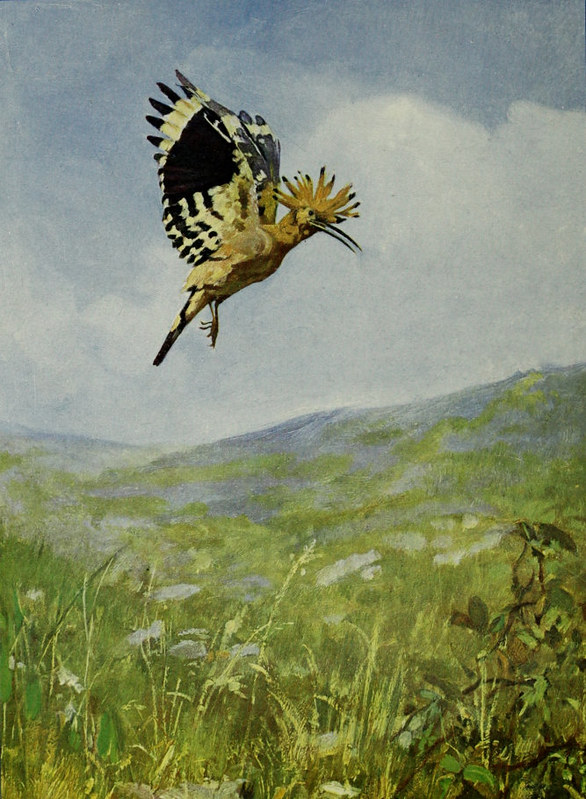
This curious plate, depicting a Eurasian Hoopoe (Upupa epops), appeared in several early 20th century books. It’s by a photographer from Athens, Charles N. Mavroyeni, and is captioned as a photograph, but clearly includes much over-painted colour, by an uncredited hand.

Hoopoe

I’m trying to find out more about Mavroyeni — not least his date of death, to determine the copyright status of his work, and thus whether it can be used in Wikipedia.

I’ve compiled what little information I can find about Mavroyeni, into an item on Wikidata (a sister project of Wikipedia, that hosts linked, open data).

As well as ornithological subjects, he photographed insects and reptiles. One picture, published in the 23 June 1906 issue of ”Country-side: A Wildlife Magazine” (page 96), depicted a beetle in flight — quite something for 1906! Sadly, it is missing from the only scan of the work I can find. Most of his published photographs, that can be found online, are monochrome and not overpainted. In the 1920s he made short films of botanical interest.

According to the same issue of ”Country-side”, he had:

the reputation of the cleverest naturalist photographer in Eastern Europe [and] there can be no doubt that if [his pictures] are not the results of simple photography, they represent the most skilful art

The above version of the Hoopoe plate appears in The Living Animals of the World, Volume 2, by Charles J. Cornish et al., circa 1902. The photographer was credited, as he often was, as “C. N. Mavroyeni”

The image file came from a copy on The Gutenberg Project; a different scan of the same work is available on the Biodiversity Heritage Library.

Another version of the plate is in the two-volume Birds of Our County; and can be seen in the recent Amazon listing of a copy (should anyone want to treat me!).

An open letter to Rupa Huq, MP, regarding official Parliamentary videos

Dear Dr. Huq,

I have been very interested to read about your recent call for an end to the prohibition on the use of footage from official parliamentary broadcasts in satirical programmes, made at the behest of your brother-in-law and constituent, the television personality Charlie Brooker.


Rupa Huq 2015

Rupa Huq

I was equally disappointed at the stance of the (Conservative) Leader of the House of Commons, Chris Grayling MP, who said:

it is very important that we make sure the coverage of this House is use in an appropriate way — I am not in favour of it being used for satire programmes.

He is wrong, because satire is not an inappropriate use of such footage, which is made with public funds.

But the right to use it in satire is not enough — we should all be able to use it wherever we want, freely. For example, on Wikipedia, for educational purposes. And for that reason, it should be made available under an “open licence”, allowing anyone to use it, for any purpose (subject, of course, to existing laws such as those on decency and defamation), with the only requirement being to attribute the source. (I have written previously about what open licensing is and why it should apply to media about politicians.)

Please take up Mr Grayling’s suggestion, and pursue your campaign with the Commons’ administration committee — but please don’t limit your request to the right to satirise. Please push for full open licensing.

Thank you.

Documenting public art, on Wikipedia

Wikipedia has a number of articles listing public artworks (statues, murals, etc) in counties, cities and towns, around the world. For example, in Birmingham. There’s also a list of the lists.

Gilded statue of three men

Boulton, Watt and Murdoch (1956) by William Bloye.
Image by Oosoom, CC BY-SA 3.0

There are, frankly, not enough of these articles; and few of those that do exist are anywhere near complete (the best is probably the list for Westminster).

How you can help

I invite you to collaborate with me, to make more lists, and to populate them.

You might have knowledge of your local artwork, or be able to visit your nearest library to make enquiries; or to take pictures (in the United Kingdom, of “permanent” works, for copyright reasons — for other countries, read up on local ‘Freedom of Panorama‘) and upload them to Wikimedia Commons, or even just find coordinates for items added by someone else. If you’re a hyperlocal blogger, or a journalist, perhaps you can appeal to your readership to assist?

Practical steps

You can enter details of an artwork using the “Public art row” family of templates. A blank entry looks like:


{{Public art row
| image =
| commonscat =
| subject =
| location =
| date =
| show_artist= yes
| artist =
| type =
| material =
| dimensions =
| designation =
| coordinates =
| owner =
| show_wikidata= yes
| wikidata =
| notes =
}}

(change “yes” to “no” if a particular column isn’t wanted) and you simply type in the information you have, like this:


{{Public art row
| image = Boulton, Watt and Murdoch.jpg
| commonscat = Statue of Boulton, Watt and Murdoch, Birmingham
| subject = ''[[Boulton, Watt and Murdoch]]''
| location = Near the House of Sport – Broad Street
| date = {{Start date|1956}}
| artist = [[William Bloye]]
| type = statue
| material = Gilded [[Bronze]]
| dimensions = 10 feet tall
| designation = Grade II listed
| coordinates = 52.478587,-1.908395
| owner = [[Birmingham City Council]]
| show_wikidata= yes
| wikidata = Q4949742
| notes = <ref>http://www.birminghammail.co.uk/whats-on/things-to-do/top-5-statues-birmingham-5678972</ref>
}}

Apart from the subject, all the values are optional.

In the above (as well as some invented values for illustrative purposes):

but if that’s too complicated, you can just enter text values, and someone else will come along and do the formatting (experienced Wikipedians can use the {{Coord}} template for coordinates, too). If you get stuck, drop me a line, or ask for help at Wikipedia’s Teahouse.

What this does

The “Public art row” template makes it easy to enter data, keeps everything tidy and consistently formatted, and makes the content machine-readable, That means that we can parse all the contents and enter them into Wikidata, creating new items if required, as we go.

We can then include other identifiers for the artworks in Wikidata, and include the artworks’ Wikidata identifiers in other systems such as OpenStreetMap, so everything becomes available as linked, open data for others to reuse and build new apps and tools with.

United Kingdom parliamentary URL structure: change needed

In Wikidata, Wikipedia’s sister project for storing statements of fact as , we record a number of unique identifiers.

For example, Tim Berners-Lee has the identifier “85312226” and is known to the as “nm3805083”.

We know that we can convert these to URLs by adding a prefix, so

by adding the prefixes:

  • https://viaf.org/viaf/
  • http://www.imdb.com/Name?

respectively. We only need to store those prefixes in Wikidata once each.


HOUSES OF PARLIAMENT DSC 7057 pano 2

The in August 2014,
picture by Henry Kellner, CC BY-SA 3.0

The United Kingdom Parliament website also uses identifiers for MPs and members of the House of Lords.

For example, Tom Watson, an MP, is “1463”, and Jim Knight, aka The Lord Knight of Weymouth, is “4160”.

However, the respective URLs are:

meaning that the prefixes are not consistent, and require you to know the name or exact title.

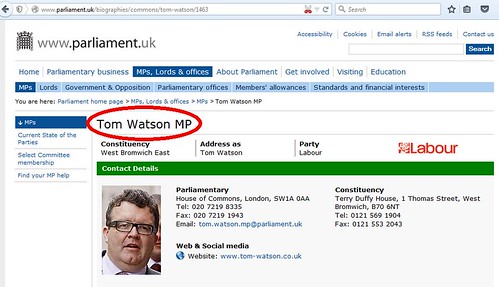
Yet more ridiculous is that, if Tom Watson ever gets appointed to the House of Lords, even though his unique ID won’t change, the URL required to find his biography on the parliamentary website will change — and, because we don’t know whether he would be, say Lord Watson of Sandwell Valley, or Lord Watson of West Bromwich, we can’t predict what it will be.

When building databases, like Wikidata, this is all extremely unhelpful.

What we would like the parliamentary authorities to do — and what would benefit others wanting to make use of parliamentary URLs — is to use a standard, predictable type of URL, for example http://www.parliament.uk/biographies/1463 which uses the unique identifier, but does not require the individual’s house, name or title, and does not change if they shift to “the other place”.

If necessary they could then make that redirect to the longer URLs they prefer (though I wouldn’t recommend it).

I’ve asked them; but they don’t currently do this. In fact they explained their preference for the longer URLs thus:

…we are unable [sic] to shorten the url any further as the purpose of the current pattern of the web address is to display a pathway to the page.

The url also identifies the page i.e the indication of biographies including the name of the respective Member as to make it informative for online users who may view the page.

I find these arguments unconvincing, to say the least.


Screenshot, with Watson's name in the largest font on the page

There’s a big enough clue on the page, without needing to read the URL to identify its subject

Furthermore, the most verbose parts of the URLs are non-functioning; if we truncate Tom’s URL by simply dropping the final digit: http://www.parliament.uk/biographies/commons/tom-watson/146, then we get the biography of a different MP. On the other hand, if we change it to, say: http://www.parliament.uk/biographies/commons/t/1463, we still get Tom’s page. Try them for yourself.

So, how can we help the people running the Parliamentary website to change their minds, and to use a more helpful URL structure? Who do we need to persuade?

HLF licensing requirement considered harmful

This morning I attended a very interesting presentation on the availability, in the United Kingdom, of grant funding from the (HLF), for digital heritage projects. I’ve previously worked as Wikipedian in Residence or as a Wikipedia consultant on HLF-funded projects*, helping to disseminate knowledge and content generated by those projects via Wikipedia, via Wikimedia Commons and via Wikidata.

Badge reads 'Birmingham Socialist A.R.P. Canteen fund' and has a drawing of ARP wardens being served at a mobile canteen

This fantastic image of a World War II badge was taken by Sasha Taylor during a Wikipedia editathon I ran as part of my HLF-funded residency at Thinktank, Birmingham Science Museum. Because Sasha was a volunteer, he’s not bound by HLF rules, so was able to use a CC BY-SA licence, and I was then able to add the image to Wikipedia articles. With an NC restriction, I couldn’t have done so.

As part of the presentation, it was proudly pointed out that the HLF’s current terms of funding include:

All digital outputs must be… licensed for use by others under the Creative Commons licence ‘Attribution Non-commercial’ (CC BY-NC) for the life of your contract with HLF, unless we have agreed otherwise

However, I’m really irked by this. I’ve written previously about what this means and why Wikipedia and its sister projects require content to be under a less restrictive licence, allowing for commercial reuse (briefly: people are allowed to reuse content from Wikipedia in commercial situations, for example in newspapers, or in apps which are sold for use on mobile devices). Others — have — written about why the NC restriction can be harmful.

Of course, mechanical copies of out-of-copyright works should be marked as such, and no attempt to claim copyright over them should be made.

In response to my question, it was confirmed that the terms prohibit less-restrictive licences, even if those doing the work wish to use them.

[Admittedly there is a work-around, which is to dual licence as both CC BY-NC and a less-restrictive version; which technically meets the letter of HLF’s requirement, but is actually nonsensical.]

I can see no earthly reason why HLF would insist on prohibiting a less restrictive licence, if the bodies they are funding choose to use one. If I’ve missed something, I’d be grateful for an explanation.

The phrase “for the life of your contract with HLF” is also nonsensical, since such licences are both indefinite and irrevocable.

I would like to see the above wording changed, to something like:

All digital outputs must be… licensed for use by others under the Creative Commons licence ‘Attribution Non-commercial’ (CC BY-NC) or a less restrictive licence (e.g. CC BY, CC BY-SA, or CC0), unless we have agreed otherwise

Better sill, HLF could mandate an open licence, unless agreed otherwise.

How about it, HLF?

* If you’re bidding for HLF funding and would like advice about including a Wikipedia component, please drop me a line#.

# That might lead to someone paying me. Some would argue that that means I can’t use a NC-restricted image on this page.

Public Keys in ORCID Profiles

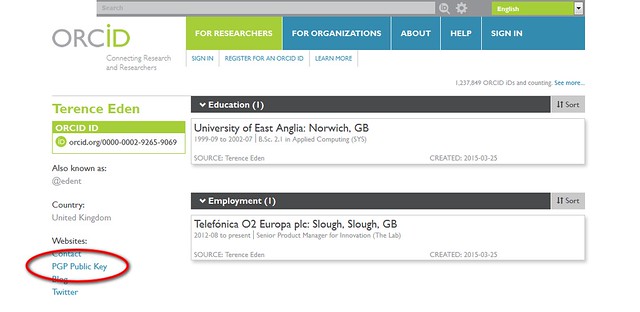
My friend Terence Eden is knowledgeable (and blogs wittily and accessibly) about IT security issues. He’s also a vociferous advocate of PGP, a computer program for the encryption and decryption of data and communications. At my suggestion, he just registered for an ORCID iD (it’s 0000-0002-9265-9069), and the first thing he did was to include a link to his PGP Public key in his ORCID profile.

ORCID Profile for Terence Eden

That’s the first time I’ve seen this done.

Perhaps more people should include links to public keys in their ORCID profiles? Maybe ORCID could consider a separate parameter for this (or is the “websites” section of the profile adequate)? What do you think?

But whatever you do, when you link to your PGP public key from your ORCID profile, don’t use Bit.ly!

Note: I’m Wikipedian in Residence at ORCID. An ORCID (Open Researcher and Contributor ID) identifier is a nonproprietary alphanumeric code to uniquely identify scientific and other academic authors and content contributors — like an ISBN, but for people.

Matching ORCID and other authority control identifiers in Wikidata BEACON

Further to my previous post on finding ORCID identifiers used in Wikidata & Wikipedia, Magnus Manske has released another useful gadget. “Wikidata BEACON” is a new tool that matches individuals’ (or other subjects’) entries in two different authority control systems. One of these, of course, can be ORCID.

For example to find people who are listed in Wikidata, and have an ORCID identifier recorded there, and who also have, say, a VIAF identifier, or a MusicBrainz artist profile, choose one of those properties, then the other, from the two drop down menus, then select “Get BEACON data”.

screenshot

Screenshot of Beacon, with ORCID and VIAF identifiers selected.

The result is returned as a pipe (“|“)-separated list, with the middle of the three columns being the Wikidata ID (in the format “Qnnn“) of the item concerned. (For the technically inclined, the format is BEACON, used to enable third party data re-users to automate the conversion of identifier values into web links. You can see the part-URLs, to which the values must be appended, at the head of the results page, labelled #PREFIX and #TARGET)

So, Bill Thompson, for instance, appears as:

4426461|Q4911143|0000-0003-4402-5296

showing respectively, his VIAF (4426461), Wikidata (Q4911143), and ORCID (0000-0003-4402-5296) identifiers

A query can also be made in the form of a URL, for example this one:

https://tools.wmflabs.org/wikidata-todo/beacon.php?prop=496&source=214

in which “496” is from Wikidata’s code for an ORCID identifier and “214” for a VIAF identifier.

Another example is:

https://tools.wmflabs.org/wikidata-todo/beacon.php?prop=661&source=373

which shows the identifiers of chemicals in the Royal Society of Chemistry’s ChemSpider database and the matching Wikimedia Commons categories.

Similarly:

https://tools.wmflabs.org/wikidata-todo/beacon.php?prop=827&source=345

matches the BBC and Internet Movie Database (IMDb) identifiers of television programmes.

Beacon is a good illustration of the way in which Wikidata has become a hub linking disparate datasets about people, and other things; as described by Andrew Gray in “Wikidata identifiers and the ODNB – where next?“.

Finding ORCID identifiers used in Wikidata & Wikipedia

As you may know, I’m was appointed Wikipedian in Residence at ORCID in June this year.

I’ve previously written a guide to using ORCID identifiers in Wikipedia.

A new tool, ‘Resolver‘, by my friend Magnus Manske, who has awesome coding skills, and is generous with them, allows you to find whether a particular ORCID identifier is used in (and thus in one or more Wikipedia projects, in any language).

By entering the property “P496” (the Wikidata property for an ORCID ID) and the ORCID ID value (the short form, e.g. “0000-0003-4402-5296”, not the full identifier, “http://orcid.org/0000-0003-4402-5296”) into Resolver, the relevant Wikidata page, if any, is retuned. At the foot of that page are links to Wikipedia articles (again, if any).

Resolver screenshot

An ORCID identifier query in Resolver

Alternatively, you may compile a URL in the format https://tools.wmflabs.org/wikidata-todo/resolver.php?prop=P496&value=0000-0003-4402-5296 – which will automagically redirect.

Note that this works for articles, but not identifiers used on Wikipedia editors’ user pages, which have no Wikidata equivalent.

Resolver works with other unique identifiers, too, such as VIAF, or BBC Your Paintings artist identifiers, and many more. If you want to know why that’s important, see Andrew Gray’s post, “Wikidata identifiers and the ODNB – where next?“. Resolver is not just for people, though. It will also resolve unique identifiers for other types of subjects, such as BBC programme IDs or ChemSpider IDs for chemical compounds.