Google Books: please make better use of screen space on my netbook

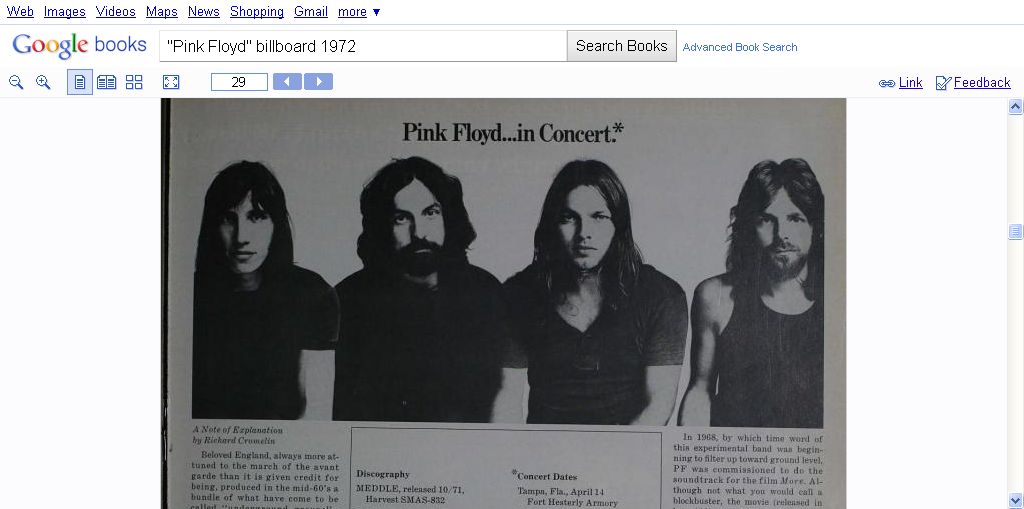
The screen-shot below shows the appearance of a 15 April 1972 Billboard magazine article about Pink Floyd, in Google Books, on the screen of my Lenovo S10-S2 netbook, using my default settings. 

Screengrab, showing the top of a scanned magazine page, with a picture and then only a few lines of text showing

Although I’ve used Google Books’ “full screen” setting, this only uses the full width of the screen, not its height. Of the viewport’s 509 pixels height, virtually a fifth, 98 pixels, are taken up with navigation tools which are, while I’m reading the article, redundant:

The top of the previous screengrab, showing navigation links

It would be good if Google would let me hide that header until I need it again, and thereby reduce the amount of vertical scrolling needed as I read the multi-column content.

Unusual behaviour of Blue Tit at nest site

During a walk in , Birmingham, this morning, organised by the RSPB Walsall Local Group (of which I am a committee member, webmaster and speakers’ secretary — I multitask!) we observed what may be unusual behaviour. A bird (or possibly a pair) were entering as nest site in a dead tree stump (probably Silver Birch (Betula pendula) ) by one hole, near the ground, but instead of leaving by the same hole, exiting via another, higher up.

The two holes are marked on my photograph:

Nest holes about 18 inches and 36 inches from the ground.

The adult was (or were, if both parents were involved) obviously bringing in food to feed nestlings inside the tree trunk. We observed five visits to the nest, and on four occasions the adult left by the higher hole. On the other visit, it left by the hole used as an entrance. At no time did we see more than one adult at once. Did each member of the pair perhaps favour one exit over the other?

I managed to grab a brief video of the final visit, using my , which I subsequently cropped heavily using Avidemux video editing software. The entrance is used in the first second or two, so you’ll have to pay close attention! Then there’s not much to see until it leaves 12 seconds later.

Unfortunately, pressure of time prevented further study.

Presumably, the nest was below the bottom hole — so why did the bird(s) pass that hole to leave by the higher one?

The mysterious case of Birmingham’s missing Victorian cast iron urinal

My recent post about a metadata standard for syndicating information about public toilets, reminded me of an incident that occurred over 20 years ago, and questions about it, which have vexed me for years since…

In late 1986 and early 1987, to make way for the construction of the International Convention Centre in Birmingham, a number of older buildings had to be demolished, and entire streets disappeared.

West to East: St Martin's Place, Edward Street and Alfred Place, running parallel, between Broad Street and Cambridge Street

1949 map showing St Martin's Place, Edward Street and Alfred Place

On one of those, Edward Street, was a cast-iron street urinal. This was a listed structure: despite its mundane function, it was an impressive and decorative piece of Victorian engineering. The (then) Department of the Environment only gave permission for its removal on the condition that it was re-erected elsewhere. At the time, I was a volunteer at Birmingham Railway Museum, and so in January 1987 I wrote, formally, on behalf of the museum, with the approval of its management, to the City Council, offering a home for the urinal at the museum.

This request was refused by a council officer.

It was with some surprise, therefore, that we read in the Birmingham Evening Mail on 14 February 1987, an appeal from “Birmingham council chiefs” for a new home for the urinal:

Yellowing press clipping from 14 Feb 1987, showing the urinal

Birmingham Evening Mail, 14 February 1987

There were suggestions from members of the public that the urinal could go to the Black County Museum, or Avoncroft Museum of Historic Buildings — neither of which, unlike the Railway Museum, were in Birmingham, or had indicated any interest in the structure:

Yellowing press clipping from 21 Feb 1987, showing the 'Philip Colmore' column logo

Birmingham Evening Mail, 21 February 1987

I wrote to the Evening Mail, and to the Council, pointing this out:
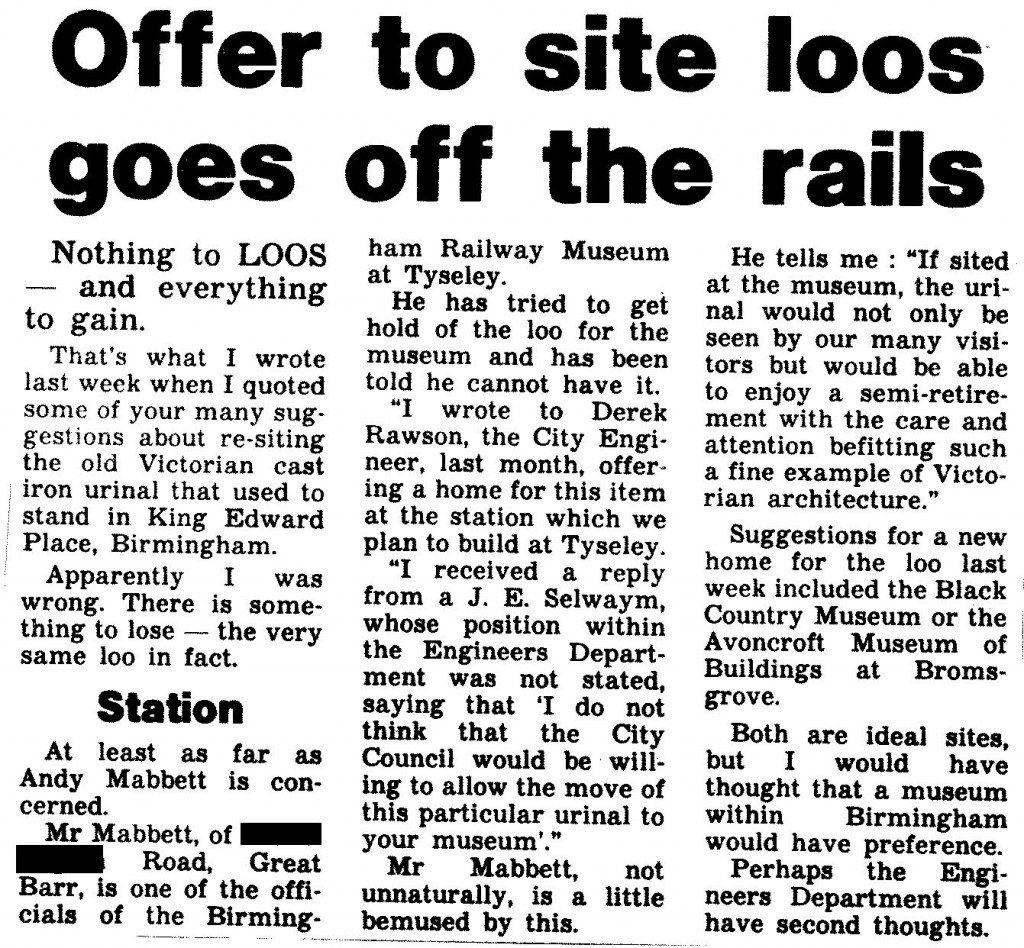
Yellowing press clipping from 128 Feb 1987

Birmingham Evening Mail, 28 February 1987

Eventually, after reconsideration, the council’s Technical Services Committee (made up of elected members) agreed that the Railway Museum could after all have the urinal.

It was about this time that my ten years of volunteering at the museum came to an end, but I was told that the urinal had been dismantled and delivered to the museum, where it was placed in store.

Remarkably, the museum now tell me:

It is believed that the urinal was disposed to another museum … but I regret that at this length of time there is no record of where

So, where is our listed urinal — part of the City’s cultural heritage — now? Did the museum obtain — or need — the council’s or English Heritage’s permission to give up this object? Why were the public not consulted about the change of location, as they were the first time around? And did the council fail its legal duty to see that it was re-erected?

Update, 25 May 2011: One of my moles has suggested to me that the urinal may never have been delivered to Birmingham Railway Museum, and that it may even be languishing in a Birmingham City Council store. Are either of these things true? Let’s hope we find out. Meanwhile, the mystery deepens!

Update, 3 June 2011: The Birmingham Mail have written about this post, and there’s a Birmingham Post article about this post, too.

Update, 22 September 2011: Birmingham City council have just informed me that the urinal they have in store (referred to in my 25 May update) is not the one from King Edward’s Place, which their records say was sent to Birmingham Railway Museum. They are trying to locate the relevant paperwork for me. So the issues remain: where is our urinal, and was the legal requirement to reinstate it complied with?
Alan Sugar, Digby Jones and me, in the Daily Express

You’ll never see a nipple in the Daily Express according to .

But you can read about my new freelance career, thanks to reporter , whose article, “The Apprentice Proves that Britain Means Business“, is in both their on-line and paper editions, today. (You’ll notice that I’ve done the Daily Express the courtesy of linking to them, Like most mainstream newspaper sites, they don’t link to their subjects.)

Ros says of me:

This February it was revealed more than 4,000 Birmingham City Council jobs were being axed over the next three years to save £300million. Andy Mabbett was one of those who opted for voluntary redundancy after 21 years working for the local authority, the past 17 of them as a website manager.

At the age of 47 he’s setting up on his own as a consultant in online community building. “I had offers of work even before I left,” he said. “I’m lucky to have good contacts, good experience and saleable skills. Although there are cutbacks everywhere there are still things that need to be done and so there’s a market for people who can do them.”

I never thought I’d be mentioned in the same article as or . They must be chuffed.

Syndicating Customisable Hyperlocal Blog Content

Background

I recently described how I have started writing for the B44 hyperlocal blog, with a post about election leaflets:

'Election Leaflets' post on The B44 blog

After posting that, I realised that it fitted will with an idea I’ve been mulling over for some time: the syndication of hyperlocal blog content, with, critically, scope for customisation to suit various local audiences.

I mentioned on Twitter that my post could be reused, and re-written , under a CC-BY-NC-SA license. In other words, that’s Creative Commons, attribution (“BY“) required, Non-Commercial, Share-Alike.

A couple of my followers said that they would like to reuse it. After some cajoling, was the first to do so, amending and reusing my post on the ‘Visit Burslem’ blog:

'Election Leaflets' post on Burslem blog

Note how she changed the fourth paragraph to refer to the Stoke-on Trent North wards. For good measure, she also reused my post on the ‘Social Stoke’ blog, but due to an accident of electoral geography, without needing further changes:

'Election Leaflets' post on the Stoke blog

Then, after much further cajoling, Philip John used my post on the Lichfield Blog. He not only changed my fourth paragraph, but prepended a couple more of his own:

'Election Leaflets' post on The Lichfield Blog

Discussion

To my mind, this exercise raises several questions.

Primarily, do hyperlocal bloggers want to use content like this?

There’s certainly a lot of satisfaction to be had by seeing one’s own work published; is there less satisfaction when adapting something written by someone else? Does that matter? Is that why Philip wrote additional paragraphs? Doesn’t he have enough to do?

Why didn’t more hyperlocal bloggers reuse my post?

Was it insufficiently interesting, or badly written? Surely not! Perhaps they didn’t know about it?

Do hyperlocal blog readers mind seeing re-used content?

I’d suggest not — I contend that many such readers only read one hyperlocal blog. It’s only those of us fascinated by the hyperlocal blogging phenomenon who would be reading blogs about Great Barr (B44), Burslem and Lichfield. And providing there is openness about the source, and what’s been done, where’s the problem?

How can we do this better?

How can we let hyperlocal bloggers know when suitable content is available? Can we automate the process? Can, and should, we clearly delineate the parts which are intended to be localised? Can we find some way to export, from the original post, the tags, so that re-users can modify them? Can we export whole posts (retaining HTML markup) from one WordPress bog (be it wordpress.com or a self-hosted wordpress.org installation) and have it imported into another (ditto)? What about other platforms?

What license should be used?

CC-BY-NC-SA was perhaps too restrictive; on the other hand, can this model be monetised? Is there sufficient content of this type to make that worthwhile? Would press officers start to supply pre-written content? Would that be a good thing, or bad?

As usual, your comments — especially, but not only, if you’re a hyperlocal blogger — would be welcome. And you’re still welcome to reuse my post.

Footnote

Clare and Philip are both good friends. Please read my comments about them as the good-natured teasing they are. I trust they’ll forgive them, and my using them as unwitting guinea-pigs.

Footnote 2

Read about my new freelance career as an advisor on on-line communities and related issues.

Making a Difference to My Career

As you may know, I left my job with Birmingham City Council (after 21 years!) at the end of April, and am now in the process of setting up as a freelance advisor on online communities and content. I’ll write more about that soon; it was my plan to take May off, to do some bird watching, relax, and plan my future activities — including trying to come up with snappier way to describe the services I’ll be offering!

However, I was delighted to be immediately approached by Vicky Sargent of Boilerhouse, and asked to be part of the ‘Making A Difference with Data‘ project, set up to spread understanding about open data and transparency in local public services.

My role will be to blog, and aggregate bookmarks, about good and bad practice in publishing and using open data in the roads and transport sector. (My MaDWD blog posts will be linked to, from the ‘My comments elsewhere’ section of this site; and will appear on .) I’ll also be involved in running an on-line conference in June.

I’m delighted to have found my first gig so quickly, and really looking forward to a task which focusses on a subject about which I feel passionately.

I’d be very interested to hear what you think are the issues affecting that subject; good examples you’ve come across, and relevant datasets which you’d like to see made available openly. Examples from overseas are especially welcome.

HashMash: My invention of a new hashtag search tool

Yesterday, while reading through the for last Monday’s superb Twicket event (for background, read the , which I wrote), I started to notice that other hashtags had been used in tweets discussing it. I started to wonder which had been used the most, and what subjects they were about, and this gave me an idea, which I posted to Twitter:

Sadly, my coding days were so long ago that I no longer have the technical skills to make that happen.

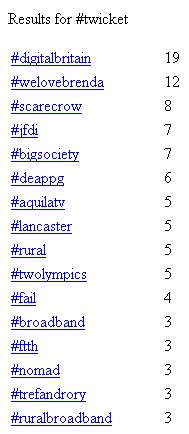
Top tag is #digitalbritain, followed by #welovebrenda

Tags tweeted alongside #twicket

Then Rachel Beer () kindly retweeted my comment, and one of her followers, Simon Painter (), immediately responded that it was was something he could do. That evening, he already had a first daft up-and-running, and the tool, which I named “HashMash”, is now available for public use at . He’s done a superb job, it works just how I imagined it would. (Nonetheless, Simon tells me that he plans to make a jquery version and beautify it).

He kindly credited Rachel and me in the footer, so I recoded the footer to include links, and “tag” , and popped my amendments to Simon’s markup onto the very useful PasteBin website, which has syntax highlighting.

Just one minute later, Simon had uploaded my new markup.

Footer includes links to Andy Mabbett's and Rachel Beer's websites and Twitter accounts

The revised HashMash footer

Bearing in mind that Simon and I have never met, had never corresponded, and weren’t even following each other on Twitter until this happened, this has been a first-class example of the power of social media, and the JFDI approach to getting stuff done. In many large organisations, the first meeting about a project initiation document wouldn’t even be scheduled.

Why not ? Let me know what you think.

Simon and Rachel: Thank you. I owe you both a beer!

Footnote: Simon has the best Twitter disclaimer ever.

Update: Simon has written a .

Update 2: Following design changes, my “footer” markup is now at the top of the page!

My name is Andy Mabbett, and I’m a Hyperlocal blogger

Recently, I’ve been increasingly interested in the phenomenon of ‘hyperlocal’ blogging: blogs about a particular area or locality (or, in one of my favourite and rather extreme cases, a single square metre).

Some fantastic work has been done by my friends at Talk About Local, whose site will tell you all you could ever need to know about about hyperlocal blogs.

For a long time, I’ve been contributing to the debate about how hyperlocal blogs might evolve, for example organising events such as the Hyperlocal Govcamp West Midlands (aka ) unconference, the first such event to introduce hyperlocal bloggers to local government web folk and other public sector people. I’ve also attended others, like the excellent TAL11 in Cardiff. I’ve also taught hyperlocal bloggers to use WordPress and other tools, at Social Media Surgeries. My hyperlocal activity even pre-dates blogging — I was the instigator and founder of the Usenet discussion newsgroup uk.local.birmingham, in 1998.

Having talked the talk for so long, I’ve finally decided to walk the walk, and am now a contributor to my local blog, The B44 (B44 is the postcode for where I live, covering parts of the Great Barr and Kingstanding parts of north Birmingham).

My first post there is on the subject of . That and future posts will appear under the “My comment elsewhere” section of this blog.

I’m grateful to the site’s founder, , for the opportunity to participate.