Category Archives: web standards

Do you make comments on others’ blogs? Bookmark and share them!

You may notice (on the right hand side of this site, if you use the default view; or see image below), a list headed “My comments elsewhere”, with links to other people’s blog posts, on which I’ve recently commented.
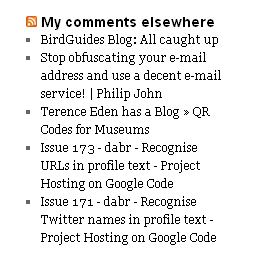
List of the five last posts on which I commented, each linked to the post concerned

Screen shot of my recent comments, at the time of writing

I’ve been asked how I do this.

Every time I comment on a blog post — and I try to do so often, both to show my interest in others’ work, and to be part of their conversations — I bookmark that post on the site Delicious Pinboard, and tag it “comment”.

I then pass the RSS feed of all my bookmarks with that tag: http://feeds.pinboard.in/rss/u:pigsonthewing/t:comment/ to WordPress (the software I use to author and host this blog), which magically displays a list of the most recent five, as you can see.

The full feed is, of course, also available to anyone who wishes to subscribe to it in the feed reader of their choice; and my tagged comments can also be read as a web page.

In this way, as well as telling my readers what I’ve done, I bring extra attention to the blogs I comment on, thereby helping, albeit in a small way, their authors.

Why not bookmark your comments, and put a feed of them on your own blog?

Update: Delicious became awful when it relaunched, I now use Pinboard.

Update: You can also use this technique to add the list of your comments (specifically, the relevant URL on the bookmarking site) as a “work”, in your profile page on services which list your publications, such as ORCID.

This weekend was indistinguishable from magic

Today, I updated someone else’s website, with one button-press on my Nokia N95 mobile phone.

The button-press was all that was need, using the lovely Dabr web interface for Twitter, to favourite a tweet about an excellent event I attended yesterday, UK GovCamp 2011.

That tweet contained a URL, and a .

Packrati.us monitors the tweets I favourite, as well as everything I tweet or re-tweet, for both links and hashtags, and saves the URLs, duly tagged, to Delicious.

Delicious then produces an RSS feed for (as they do with every tag).

Steph Gray (@lesteph) has done an excellent job, using Commentariat2 and WordPress to make the conversation aggregator (a “buzz” page) for UK GovCamp 2011, and has kindly accepted my suggestion to include the Delicious RSS feed for the event’s hashtag.

And so the link in the tweet I favourited appeared on the “buzz” page of the UK GovCamp 2011 website.

All because I made a single button-press on a device little bigger than a matchbox.

To quote the already over-quoted Arthur C Clarke‘s ‘Third Law‘:

Any sufficiently advanced technology is indistinguishable from magic

Thirty-five years after I first (at a very youthful age!) used a computer, and seventeen years after I first used the web, I’m still excited by them. I wonder where they’ll take us next?

The event was indistinguishable from magic, too. The links above will show you why.

A proposed tag for including Wikipedia links in Twitter posts

I’ve had another idea!

I saw Matthew Somerville () tweet:

Reading about http://en.wikipedia.org/wiki/Clothianidin and bees

and it occurred to me, both that a fantastically high number of Wikipedia links are tweeted, and that Wikipedia URLs are relatively long. This latter fact might have been significant, if Matthew had needed to say a few more words, or was talking about something with a longer name. He could have shortened his link, using, say, Bit.ly, but then he’d have had to repeat the stem:

Reading about Clothianidin http://bit.ly/dE6pUf and bees

which is hardly shorter, and disrupts the flow.

What if we agreed a special tag, say W# or w:, used like this:

Reading about w:Clothianidin and bees

and Twitter clients automatically swapped that for a Wikipedia link:

Reading about Clothianidin and bees

Update

Twitter clients could allow users to set their preferred language-version of Wikipedia, and perhaps find the relevant translations of articles (which Wikipedia could better facilitate, using rel=alternate headers), authors could also specify a language, such as w:fr:brie or w:de:München

Proposal: generate KML from postcodes in Twitter messages

Here’s an idea I’ve just had, and mentioned on Twitter:

It would be cool if someone with the necessary skills and bandwidth could provide a service which takes a Twitter search (say, for a hashtag), extracts from it , or postcode districts (the first half of a postcode, such as “B44”), and returns a corresponding KML file, which can then be passed to other services, like Google Maps.

It would enable anybody to create a service like Ben Marsh‘s excellent #UKSnow map, but on the fly, and for any term or hash-tag; and especially for one-off or short term issues. Imagine, for instance, the . I could post on Twitter, say:

I just saw a #ShootingStar in B6!

(I did, too!) and others might reply:

I saw #ShootingStar from Waverley Station, EH1 1BB

Good view of #ShootingStar in S9, too!

and we’d very quickly have a map of places from which it had been seen — in the event, such information was posted to Twitter, but there was no easy way to collate it.

A similar service, returning KML for geo-coded tweets, would also be useful, and internationally too, and something combining both might also work.

A task for an upcoming hackday, perhaps? Or one you might like to tackle…

Everything at your postcode – proposal for a new website

Over the last few weeks, I have been imagining a website for UK citizens and visitors; where they can enter their postcode and be served a page or pages of hyperlocal links about everything to do with where they live. This post is me continuing that thinking out loud; comments — including the constructively critical — are actively solicited.

Links could be almost anything, from local government services (via DirectGov and OpenlyLocal) to public transport information; from maps to fun things. They would either link to sites which use postcodes as as an argument; or would be built using the target site’s postcode-lookup API.

The site would avoid the need for each hyperlocal website to compile its own list of such links.

Here are a few such links, based on a randomly-selected postcode, B23 6UH (I simply opened a local newspaper and picked the first advert that used a Birmingham postcode). Note that the first link is computed; the rest use the postcode directly.

User would also be able to suggest additional links if they find a good web service which takes a postcode as a locator — for now, please feel free to do so in comments on this post, and I’ll add them to the above list. Purely commercial links, like individual chains’ store locators, would be excluded (a few paid for links, clearly identified as such, might generate enough revenue to cover hosting costs).

As can be seen from the above, the site wouldn’t actually store or generate content; just links. The links could be clustered under headings, or on sub-pages, like “maps”, “local services”, and “fun stuff”.

It might also be possible for the site to determine the user’s nearest postcode, using their browser or device’s GeoLocation feature, or by selection from a map. The site would also accept partial postcodes, such as “B”, “B23” or “B23 6”.

The service could perhaps be “widgetised” for inclusion on other sites. And of course, it would be possible to link to the site using postcode as an argument.

The site would, of course, make data available in RSS, OPML and open data formats; and use microformats.

Unfortunately, though be willing to collate and maintain the links and code some HTML, I lack the programming and graphic-design skills to make such a site, which means that I must rely on the good will of others. Can you help? Should I organise a hack event (a day, or an evening) at a Birmingham venue, to work on this collaboratively?

Or does such a service — curated, rather than spammy — already exist? Would it belong better as an adjunct to an existing service like OpenlyLocal or DirectGov?

Over to you…

I can teach HTML. Well.

I enjoy talking about, and teaching people to use, valid, semantically-meaningful and accessible HTML. I don’t get to do the teaching very often, so, after running a session on the correct use of HTML tables, it was heartening today to receive a complimentary e-mail from an attendee. Having little modesty, I’m going to share part of it with you:

Just wanted to say thank you for the training this week… The subject of making our pages accessible for customers is a very important one, we will now make changes to the way in which we load our pages ensuring that we meet these standards… We found it very informative, interesting and unlike other training we’ve been on we didn’t walk out of there completely baffled, which is an accomplishment on your part, as the majority of us are not familiar with HTML.

Google Maps’ microformats: unhappy anniversary – still broken after three years

Three years ago today — on 31 July 2007 — Google proudly announced that they had added hCard microformats to Google Maps, so that, as they put it:

your browser can easily recognize the address and contact information in the page, and help you transfer it to an addressbook or phone more easily

Less than four hours after seeing a mailing-list repost of that announcement, by Google‘s Kevin Marks (one of the two signatories of the initial announcement), I replied, pointing out that the implementation was badly broken, and that none of the microformats in a search for a single entity, in this case a school, were valid. (As is usual on Google’s own blogs, there was no facility for comments on the original announcements.)

Google‘s Gregor J. Rothfuss, the announcement’s other signatory, replied that he would look into the matter.

Almost a month later, I asked Gregor if there had been any progress, and he said (I quote him in full):

i will work on it when i have some time.

so I took him at his terse word, and left him to it, with no further reminders. That’s the last I heard from anyone at Google on the issue.

Three years on, though the specific faults have changed, not one of the microformats in the Google Maps search linked above is valid (the mandatory “fn”, or “formatted name” property is missing; address components lack the mandatory child-properties) and I have been unable to find one that is, in other results. They are as useless to someone wanting to add the subject’s address to their address book today as they were on day one.

Update, 31 July 2011: Another year has passed, the microformats are still broken.

The Highway Code should be available as a set of linkable HTML documents, not just PDFs

The Highway Code is:

the official road user guide for Great Britain ()

Drivers must study it in order to pass a driving test, and all road users should remain familiar with it — including any revisions — throughout their lives.

It’s available online, but large parts only as a series of large PDF files. That means that when, for example, my friend Pete Ashton asks:

It’s still illegal to park on double yellow lines, right? on Twitter

I can’t easily answer him by linking directly to the section of the Road Markings PDF which says:

Double yellow lines mean no waiting at any time, unless there are signs that specifically indicate seasonal restrictions.

I would like the Highway Code to be fully available as a series of plain old semantic HTML web pages, with each section within each page having a unique ID (which even the parts already in HTML currently lack), so that I can link to the relevant, specific, section when I want to refer to it. For example, the section quoted above might be at http://www.direct.gov.uk/en/TravelAndTransport/Highwaycode/markings#double-yellow

Dear Government, Can you do that, please?

Update: I’ve asked my MP, Khalid Mahmood, to do what he can to assist with this request. I’ll let you know what happens.